Stamped Concrete Installation in Syracuse: What to Expect From Estimate to Cure
A stamped patio looks like stone or brick, but the slab underneath decides how it looks after ten winters.
October 16, 2026 · 4 min read
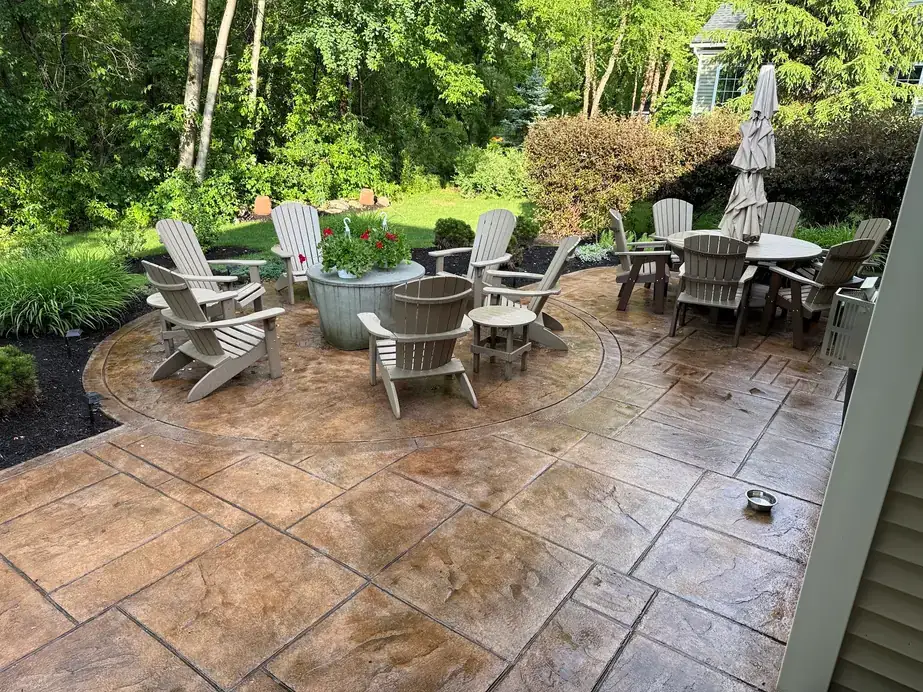
A stamped concrete patio can look like natural stone, brick or wood, but underneath the pattern it is still a poured slab, and the quality of that slab decides how the surface looks after ten winters, not just on the day the crew drives away. If you live in Syracuse or anywhere in Central New York and you are thinking about a stamped patio, walkway or pool deck, it helps to know what the job involves from the first phone call to the last coat of sealer. Here is the sequence, with notes on what we do and what to ask any contractor you are comparing.
Step one: the free on-site estimate
Every job starts with a free, personalized estimate at your property. This is where we look at the space you want to cover, how water moves across your yard, what the ground is like, and how the new concrete will meet your house, steps or existing walkways. You can book it online or call us at (315) 676-0005. Bring your ideas. Photos of patios you like, a rough sense of how you want to use the space, and questions about furniture, a fire pit or a hot tub all help. We do not publish a price list, because the cost of a patio depends on its size, its shape, the ground underneath and the pattern you choose, so the estimate is where real numbers come from.
Excavation and site work come first
Concrete is only as good as what it sits on. Excavation and site work are part of our installations from start to finish, so you are not hiring one crew to dig and a different one to pour. In general, this stage means removing old material, shaping the area so water runs away from the house, and preparing a firm, even base. A patio poured on soft or uneven ground is likely to settle and crack no matter how good the surface looks on day one. You will never see this work once the slab is down, which is exactly why it deserves a line in every estimate you read.
Rebar and a 4000 PSI minimum
All of our concrete is built with old-world practices. We reinforce it with solid rebar and use a minimum of 4000 PSI concrete. PSI is a measure of compressive strength, and rebar helps hold a slab together if the ground shifts. Central New York is hard on concrete: water soaks in, freezes, expands, thaws and repeats, and then road salt or de-icer gets involved. A strong mix with steel inside is a sensible defence. If a quote you receive says nothing about reinforcement or strength, ask about it before you sign anything.
Pattern and colour: the part you get to enjoy
Once the base is planned, the creative decisions take over. Stamped concrete can be pressed with patterns that echo natural stone, brick and wood, and the colour can be customized. Before the estimate, walk your yard and notice what already surrounds the space: the siding, the roof, the stone on the foundation, the pool coping, the fence. A stamped surface that picks up one of those tones generally looks like it belongs, while one that fights them tends to look like an add-on.
- Natural stone patterns suit informal patios and wooded yards.
- Brick patterns suit traditional homes and front walkways.
- Wood-look patterns give you the plank look without the rot and refinishing that real wood needs.
- Custom colours let you match or contrast with siding, trim and nearby stonework.
Many homeowners pick a main colour and a contrasting border to frame the slab. Look at colour samples outdoors, in sun and in shade, because concrete colour shifts with the light. Choose with the real space in mind rather than from a small sample held under a kitchen light.
Pouring, stamping and sealing
On pour day, the crew places the concrete over the rebar, finishes the surface, adds colour and presses in the pattern while the concrete is still workable. In general, timing matters a great deal at this stage, so the work moves quickly and it helps to keep children, pets and vehicles clear of the area. Joints are normally cut into the slab to control where it cracks, and then the surface is sealed. Our stamped concrete is sealed against freeze-thaw, moisture, UV and de-icing salts, which is the whole point in this climate. Sealer also gives the colour its depth.
The cure schedule, step by step
- First 24 hours: no foot traffic of any kind.
- Through 72 hours: no furniture on the surface.
- Through 5 days: no vehicle traffic.
- About 30 days: the concrete is fully cured.
Some blotchy discoloration is normal in the early weeks and fades as the slab cures, so do not panic over the first look. Think ahead about winter, too. We advise against ice melt on new concrete. Sand is preferred for traction, calcium chloride is the fallback if you truly need it, and plastic shovels are the safest choice for clearing snow.
Plan to reseal after the first winter, then about every three years, depending on how much sun and traffic the surface sees. Resealing is cheap protection compared with the slab it guards. When you do reseal, ask about an anti-skid additive, which we recommend on reseals, especially around pools and steps.
If you would like to see what a stamped patio could look like at your home, we offer a free on-site estimate. Call (315) 676-0005 or book online, and we will walk the space with you.
Distinctive Stone & Concrete, (315) 676-0005
Call (315) 676-0005More articles
Sealing a Backyard Patio or Pool Deck Around Clay and Syracuse
Sealer is what stands between your concrete and a Central New York winter, so it is worth choosing well.
Why Concrete Works for Outdoor Spaces in Central New York
Freeze-thaw cycles, plow blades and road salt are the real test for any outdoor surface in this region.